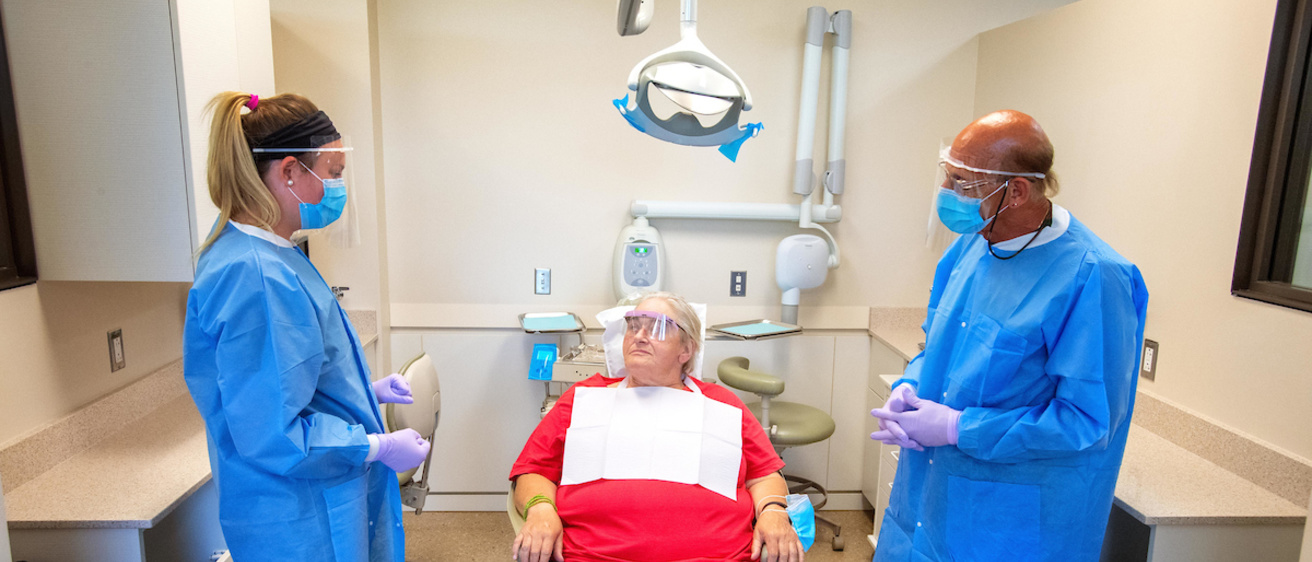
Geriatrics & Special Needs
The Certificate Program in Geriatric and Special Needs Dentistry (GSND) develops dentists who are skilled in caring for medically complex adults and committed to advancing care for vulnerable populations. Over the course of one year, participants gain specialized clinical expertise and the ability to teach, advocate, and lead in geriatric and special needs dentistry.
Overview
Established in 2012, the Certificate Program in Geriatric and Special Needs Dentistry at the University of Iowa offers a comprehensive educational experience that integrates clinical training with didactic learning. Designed to prepare dental professionals for the unique challenges of caring for older adults and individuals with special health care needs, the program emphasizes a holistic approach across the full continuum of care—from preventive services to complex treatment planning.
With Iowa’s aging population and rising disability rates, the program focuses on delivering patient-centered dental care that addresses complex medical and social needs. Residents gain hands-on experience in preventive, restorative, prosthetic, and minor surgical treatments, while learning to adapt care for individuals with disabilities and dental anxiety. This includes the use of oral anxiolytics, nitrous oxide-oxygen sedation, and accessibility accommodations such as wheelchair lifts and bariatric dental units. Collaborations with University of Iowa Health Care, the VA Medical Center, and other institutions further enrich the learning experience.
Two key initiatives set the program apart. The Geriatric Mobile Unit delivers comprehensive dental care directly to nursing home residents, giving residents invaluable experience in community-based care using advanced portable equipment. Complementing this, the program’s robust didactic curriculum includes interdisciplinary rotations in Geriatric Medicine, Adult and Geriatric Psychiatry, and home- and community-based programs. Seminar-style courses explore current topics in geriatric and special needs dentistry, deepening students’ understanding of the medical, psychological, and social dimensions of care.
Although the program does not offer direct training in operating room-based care, our residents work with hospital dentistry providers in preparing medically compromised patients for treatment under general anesthesia. Together, these experiences equip graduates with the knowledge and skills to develop realistic, patient-centered treatment plans for individuals with complex health care needs.
Courses
Summer Session I
GSND:5700 Advanced Clinical Geriatric Dentistry I 4 s.h.
This clinical course introduces residents to the evaluation and management of the oral health needs of older adults. Residents consider relevant medical, physical, psychological, cognitive, and social factors to develop rational, patient‑centered treatment plans for aging and medically complex adults.
Fall Session
GSND:5702 Advanced Clinical Geriatric Dentistry II 4 s.h.
This clinical course provides residents with experience evaluating and managing the oral health needs of older adults. Residents consider relevant medical, physical, psychological, cognitive, and social factors to develop rational, patient‑centered treatment plans for aging and medically complex adults.
GSND:5720 Outreach/Advanced Clinical Geriatric Dentistry I 3 s.h.
This clinical course provides residents with experience delivering dental care to frail and dependent older adults in nursing homes being served by the geriatric mobile dental unit. Residents assess relevant medical and social factors and develop practical, patient‑centered treatment plans for individuals in long‑term‑care settings.
GSND:5730 Interdisciplinary Geriatric Patient Assessment I 2 s.h.
This course introduces residents to integrating oral health within overall patient care and developing effective communication and collaboration skills for working with interdisciplinary healthcare teams.
GSND:5740 Advanced Topics in GSND I 2 s.h.
This course trains residents to critically evaluate current literature in geriatric dentistry and care for adults with special health care needs. Residents present their findings at weekly seminars and participate in guided discussions to deepen their understanding of the medical, physical, psychological, cognitive, and social factors influencing patient care.
GSND:5750 Geriatric Dental Case Study Seminar I 2 s.h.
This course prepares residents to assess and integrate medical, physical, psychological, cognitive, and social factors in the care of older adults and individuals with special health care needs. Through case presentations and faculty‑guided discussions, residents develop evidence‑based treatment planning skills and deliver patient‑centered care for medically complex adults.
GSND:5770 Adv Clin Training for Developmentally Disabled Adults I 2 s.h.
This course introduces residents to the spectrum of dental care for adults with developmental disabilities and other special health care needs. Training includes managing patients with varying levels of cooperation and complexity, providing care with or without oral or inhalation anxiolysis, and making appropriate referrals for treatment under general anesthesia.
Spring Session
GSND:5703 Advanced Clinical Geriatric Dentistry III 4 s.h.
Residents continue to build clinical experience in evaluating and managing the oral health needs of older adults. As they assume greater responsibility for patient care, residents independently assess relevant medical, physical, psychological, cognitive, and social factors to develop rational, patient‑centered treatment plans for aging and medically complex adults.
GSND:5721 Outreach/Advanced Clinical Geriatric Dentistry II 3 s.h.
Residents continue to deliver dental care to frail and dependent older adults in nursing homes being served by the geriatric mobile dental unit. Residents assess relevant medical and social factors and develop practical, patient‑centered treatment plans for individuals in long‑term‑care settings.
GSND:5731 Interdisciplinary Geriatric Patient Assessment II 2 s.h.
Residents continue to gain experiences integrating oral health within overall patient care and developing effective communication and collaboration skills for working with interdisciplinary healthcare teams.
GSND:5742 Advanced Topics in GSND II 2 s.h.
This course trains residents to critically evaluate current literature in geriatric dentistry and care for adults with special health care needs. Residents present their findings at weekly seminars and participate in guided discussions to deepen their understanding of the medical, physical, psychological, cognitive, and social factors influencing patient care.
GSND:5751 Geriatric Dental Case Study Seminar II 2 s.h.
This course prepares residents to assess and integrate medical, physical, psychological, cognitive, and social factors in the care of older adults and individuals with special health care needs. Through case presentations and faculty‑guided discussions, residents develop evidence‑based treatment planning skills and deliver patient‑centered care for medically complex adults.
GSND:5760 Teaching Practicum in Geriatric Dent. I 2 s.h.
This course develops residents’ skills in clinical teaching within geriatric and special needs dentistry. Emphasis is placed on promoting learner engagement, fostering critical thinking in clinical situations, and balancing high‑quality patient care with effective instruction.
GSND:5771 Adv Clin Training for Developmentally Disabled Adults II 2 s.h.
Residents continue to gain experience in providing dental care for adults with developmental disabilities and other special health care needs. Training includes managing patients with varying levels of cooperation and complexity, providing care with or without oral or inhalation anxiolysis, and making appropriate referrals for treatment under general anesthesia.
Summer Session II
GSND:5704 Advanced Clinical Geriatric Dentistry IV 4 s.h.
Residents advance to a high level of clinical independence in evaluating and managing the oral health needs of older adults. They assume primary responsibility for patient care, independently integrating medical, physical, psychological, cognitive, and social factors to develop and implement rational, patient‑centered treatment plans for aging and medically complex adults.
Elective Courses
OMFS:5208 Pain and Anxiety Control 0-3 s.h.
Nitrous oxide; intravenous, oral, intramuscular anxiety and pain control; pharmacology of agents; complications, their management.
ORSC:5280 Advanced Dental Therapeutics 0-1 s.h.
Antimicrobial, analgesic, related therapies; emphasis on drug/drug interactions, dental implications of chronic cardiovascular and central nervous system medications. Offered fall semesters.
DPH:6017 Teaching Methods and Evaluation arr. 0,2 s.h.
Philosophies of dental education, teaching methodologies, evaluation; focus on learning to write educational objectives, writing and analyzing exam items.
OPRM:5226 Oral Pathology for Graduate Students 0-1 s.h.
Head and neck diseases, abnormalities.
DPH:5031 Geriatric Care 0,2 s.h.
Aging demographics; effects of aging on the human body with emphasis on the masticatory system; diseases commonly found among the elderly; and dental care for the elderly in different settings.
ORSC:5300 Dental Mgmt for Pts With Complex Medical History 0-1 s.h.
Risk assessment, treatment planning, medically compromised patients, systemic complications, medical emergency in dental offices. Offered fall semesters of odd years.
Typical Weekly Schedule
Monday: Clinical rotation at Geriatric Mobile Unit site / Interdisciplinary rotations
Tuesday: Didactic courses / Clinical case reviews / Administrative or lab time
Wednesday: Clinical rotation at Geriatric and Special Needs Clinic / Weekly seminar
Thursday: Clinical rotation at Geriatric Mobile Unit site / Interdisciplinary rotations
Friday: Clinical rotation at Geriatric and Special Needs Clinic
Application Process
Complete the following steps to apply to the GSND Certificate program:
Step 1: Our program participates in the American Dental Education Association Postdoctoral Application Support Service (ADEA PASS). Please visit our ADEA PASS program webpage to apply.
Step 2: Apply online through the University of Iowa’s Graduate Admissions portal—from the application sign-in page, go to the section under Graduate/Professional Applications and choose the Non-degree application. Indicate Geriatrics & Special Needs Certificate as the “Purpose for Attending”.
Step 3: Send any required additional materials to the program and the University of Iowa’s Office of Admissions.
Admission Requirements
Applicants are required meet the minimum requirements for admission to the Graduate College at the University of Iowa and the requirements of the Geriatric and Special Needs Dentistry program. Those requirements include:
- D.D.S. or D.M.D. from a CODA-accredited dental school, or foreign equivalent
- International applicants must have at least three years of recent clinical experience after graduation and/or a master’s degree or certificate in Prosthodontics. Experience within the US / Canadian dental care delivery system is desirable.
- TOEFL is required for all international applicants who are non‑native English speakers, with a minimum overall score of 100 (26 Listening, 27 Speaking) for tests taken before January 21, 2026, and a minimum overall score of 5.0 with 5.5 in Listening and Speaking for tests taken on or after that date.
Application Procedures
The deadline for application is December 1 of the year prior to the anticipated date of starting the program. 1-2 students are accepted to the program each year. A stipend may be available based on funding and eligibility. The program begins on July 1.
Materials to submit to ADEA PASS
- A set of your unofficial academic records/transcripts. If you are admitted, official transcripts will be required before enrollment.
- Educational Credential Evaluators (ECE) Course-by-Course Evaluation Report for international applicants.
- TOEFL scores for international applicants.
- National Board Dental Exam scores, if available. Recommended, but not required for international applicants.
- Three letters of recommendation
- Curriculum Vitae
- Personal statement
- Official copy of dental diploma
- Official copy of dental license
- A copy of your Supplemental Application
Materials to send to the program
- Email a recent 2 x 2 head shot photo directly to the program. State your name and application # in the subject line.
Materials Sent to the University of Iowa Office of Admissions
- A second set of your official academic records/transcripts (current and former UI students do not need to provide UI transcripts)
- International students may also be required to submit TOEFL or IELTS scores to comply with the university's English Language Proficiency Requirements.
- Once recommended for admission, international students must send a Financial Statement.
Program Information, Stipend, and Costs
Contact Information
Program Director
Dr. Rohit Nair, BDS MDS
Department of Preventive & Community Dentistry
The University of Iowa
Dental Science Building
Iowa City, IA 52242
Email
319-335-8471
Enrollment Management
The University of Iowa
2900 UCC
Iowa City, IA 52242
Email
319-335-1525